Positive Behavioral Interventions and Support (PBIS) is a proactive, systematic approach that has been found to improve the behavior outcomes of students in every grade. Staff members work together to consistently teach, model and reinforce appropriate behaviors that students are expected to use at school. PBIS teaches students to be responsible for their own behaviors. Typical expectations include: Be Safe, Be Respectful, Be Responsible. Attention is focused on creating and sustaining primary (school), secondary (classroom) and tertiary (individual) systems of support that improve chances for academic success for all children and youth.
In the past, schoolwide discipline focused on reacting to specific student misbehavior by implementing punishment-based strategies including reprimands, loss of privileges, referrals, suspensions and expulsions. But research shows that punishment is not effective when used inconsistently and without other positive strategies to encourage desired behavior. Teaching positive social behaviors creates an environment focusing on the desired behavior not the response to student misbehavior.
What is the Bully Prevention Program?
Included within the PBIS framework is the Bully Prevention Program, a research-based, proactive program that provides specific instruction to prevent bullying behavior from being rewarded by victims or bystanders. It also provides all students with tools on how to Stop-Walk-Talk to ensure a safe environment for all.
What is the role of the parent?
When families regularly participate in their student’s academic and social emotional learning, there is an increased chance for academic success for all children. Providing feedback to school staff and praise to students when progress is made are also ways families can participate in PBIS.
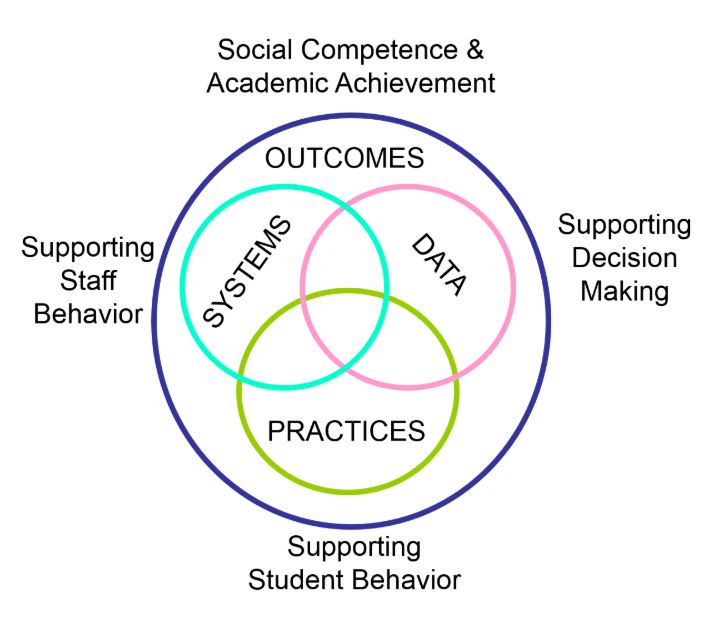
PBIS emphasizes the creation of systems that support the adoption and implementation of evidence-based practices and procedures. An interactive approach that includes opportunities to correct and improve focusing on the following four key elements.
- Outcomes – What is important to each particular learning community?
- Data – What data will you use to support your success or barriers?
- Practices – How will you reach the goals?
- Systems – What durable systems can be implemented that will sustain this over the long haul?
Tiers of Intervention
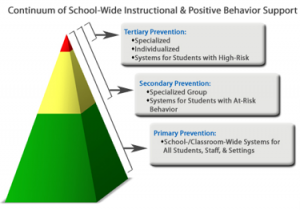
The diagram illustrates the multilevel approach offered to all students.
Tier I – Universal
In Tier I, all students receive proactive, systematic, researched based interventions that are designed to increase student learning and decrease problem behaviors. The PBIS Universal Team analyzes data from discipline referrals to determine the needs of the students. Social skills lessons (Cool Tools) are used to teach students desired behaviors. Students are acknowledged for maintaining expected behaviors. The Bullying Prevention program is also part of the universal framework. The goal of Bullying Prevention is to reduce peer problem behavior through establishing a process for handling problem behaviors by creating a systemic, cohesive, and consistent practice when responding to these behaviors.
Tier II – Secondary
In Tier II, students who are not responding to schoolwide interventions are provided another layer of support through small group intervention. Check-In Check Out (CICO) is an intervention that is used to support the relationship between students and staff. Students are given positive feedback from their teacher throughout the day. The PBIS Secondary Team develops rules for entering, monitoring progress and exiting the program.
If students are not making progress with the CICO system another layer of support can be added. Other supports include social academic instructional groups designed to teach pro-social, problem-solving, or academic behavior skills. Mentoring is established for students who need increased support through building a relationship with an adult or older peer.
Tier III – Tertiary
In Tier III, students receive intensive individualized supports based on their needs. The PBIS Tertiary Team provides services to students through wraparound plans and/or a complex Behavior Intervention Plan. Wraparound plans are designed to build relationships between students, families and the educational environment. Wraparound services are ongoing and unconditional. The team continues to change or modify the plan until the interventions in place are working to decrease problem behaviors. Students receiving Tier III interventions also continue to be supported by Tier I and Tier II levels of support.